深度神经网络中的优化算法

在深度神经网络中采用一些先进的优化算法,不仅可以加速学习速度,还有可能获得更好的结果。本文介绍深度神经网络中最常用的三种优化算法:Mini-batch梯度下降法、动量法、Adam方法,并对一个简单数据集进行测试,对比三种方法的效果。

梯度下降法类似于以最快的方式寻找代价函数这座山的最低点:
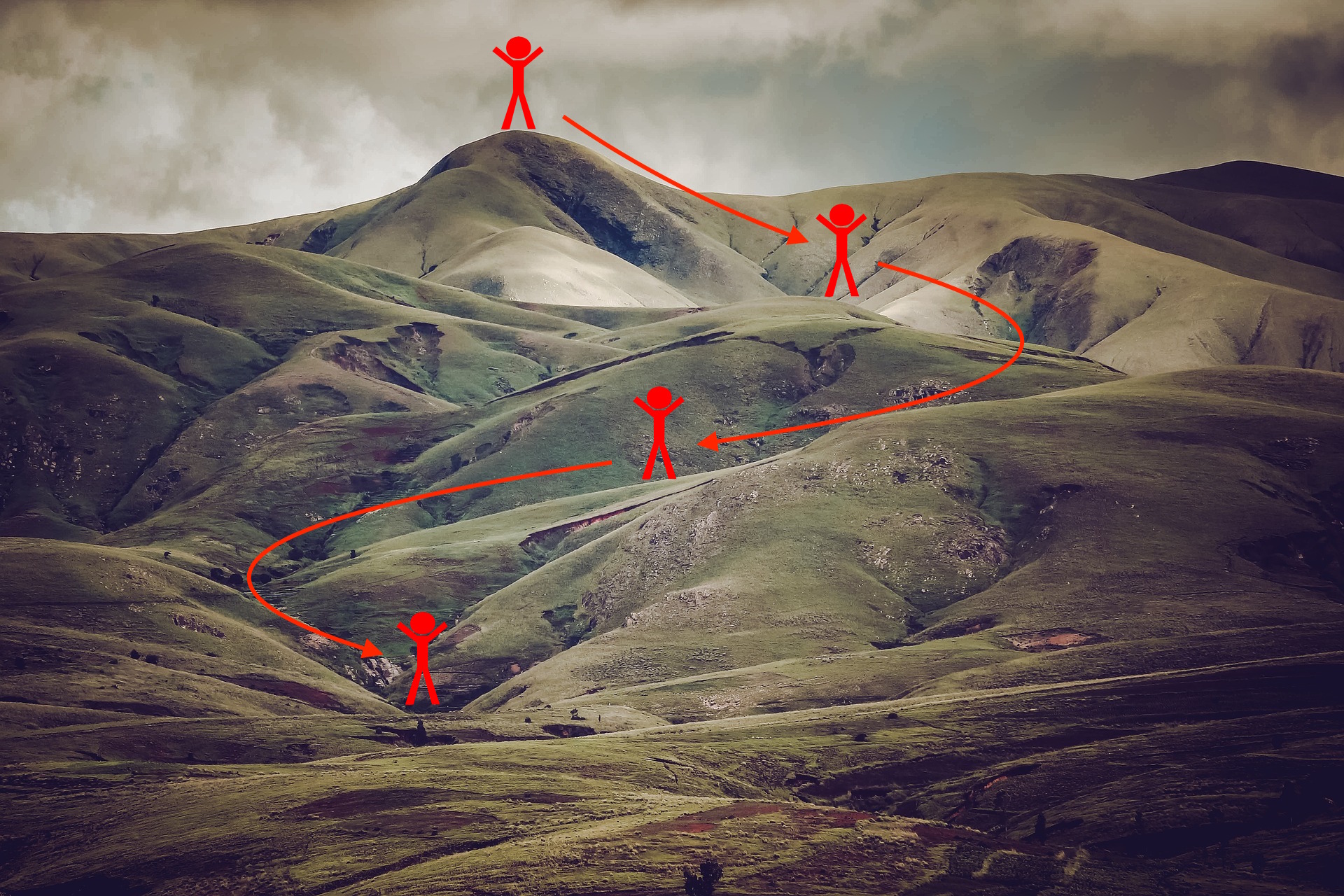
图 1 : 最小化代价函数类似于在山谷中寻找最低点
训练的每一步都是根据一定的方向更新参数,以可能走向最低的点.

标记: $ = $ da 对任意的 a.

1
2
3
4
5
6
7
8
9
10
11
12
13
14
15
import numpy as np
import matplotlib.pyplot as plt
import scipy.io
import math
import sklearn
import sklearn.datasets

from opt_utils import load_params_and_grads, initialize_parameters, forward_propagation, backward_propagation
from opt_utils import compute_cost, predict, predict_dec, plot_decision_boundary, load_dataset
from testCases import *

%matplotlib inline
plt.rcParams['figure.figsize'] = (7.0, 4.0) # set default size of plots
plt.rcParams['image.interpolation'] = 'nearest'
plt.rcParams['image.cmap'] = 'gray'
/media/seisinv/Data/svn/ai/learn/dl_ng/opt_utils.py:76: SyntaxWarning: assertion is always true, perhaps remove parentheses?
  assert(parameters['W' + str(l)].shape == layer_dims[l], layer_dims[l-1])
/media/seisinv/Data/svn/ai/learn/dl_ng/opt_utils.py:77: SyntaxWarning: assertion is always true, perhaps remove parentheses?
  assert(parameters['W' + str(l)].shape == layer_dims[l], 1)

梯度下降法

机器学习中最简单的优化方法是梯度下降法 (GD). 在每一步计算梯度过程中,如果使用所有m个样本, 该方法也称为 Batch Gradient Descent.

梯度下降准则: 对 \(l = 1, ..., L\): \[ W^{[l]} = W^{[l]} - \alpha \text{ } dW^{[l]} \tag{1}\] \[ b^{[l]} = b^{[l]} - \alpha \text{ } db^{[l]} \tag{2}\]

其中L 为层数, \(\alpha\) 为学习率. 所有的参数存储在字典 parameters 中。

1
2
3
4
5
6
7
8
9
10
11
12
13
14
15
16
17
18
19
20
21
22
23
24
25
26
27
28
29
# GRADED FUNCTION: update_parameters_with_gd

def update_parameters_with_gd(parameters, grads, learning_rate):
"""
Update parameters using one step of gradient descent

Arguments:
parameters -- python dictionary containing your parameters to be updated:
parameters['W' + str(l)] = Wl
parameters['b' + str(l)] = bl
grads -- python dictionary containing your gradients to update each parameters:
grads['dW' + str(l)] = dWl
grads['db' + str(l)] = dbl
learning_rate -- the learning rate, scalar.

Returns:
parameters -- python dictionary containing your updated parameters
"""

L = len(parameters) // 2 # number of layers in the neural networks

# Update rule for each parameter
for l in range(L):
### START CODE HERE ### (approx. 2 lines)
parameters["W" + str(l+1)] = parameters["W" + str(l+1)] - learning_rate*grads['dW' + str(l+1)]
parameters["b" + str(l+1)] = parameters["b" + str(l+1)] - learning_rate*grads['db' + str(l+1)]
### END CODE HERE ###

return parameters
1
2
3
4
5
6
7
parameters, grads, learning_rate = update_parameters_with_gd_test_case()

parameters = update_parameters_with_gd(parameters, grads, learning_rate)
print("W1 = " + str(parameters["W1"]))
print("b1 = " + str(parameters["b1"]))
print("W2 = " + str(parameters["W2"]))
print("b2 = " + str(parameters["b2"]))
W1 = [[ 1.63535156 -0.62320365 -0.53718766]
 [-1.07799357  0.85639907 -2.29470142]]
b1 = [[ 1.74604067]
 [-0.75184921]]
W2 = [[ 0.32171798 -0.25467393  1.46902454]
 [-2.05617317 -0.31554548 -0.3756023 ]
 [ 1.1404819  -1.09976462 -0.1612551 ]]
b2 = [[-0.88020257]
 [ 0.02561572]
 [ 0.57539477]]

另一个变种是随机梯度下降法,相当于min-batch=1个样本的mini-batch GD方法。

  • (Batch) Gradient Descent:
1
2
3
4
5
6
7
8
9
10
11
12
X = data_input
Y = labels
parameters = initialize_parameters(layers_dims)
for i in range(0, num_iterations):
# Forward propagation
a, caches = forward_propagation(X, parameters)
# Compute cost.
cost = compute_cost(a, Y)
# Backward propagation.
grads = backward_propagation(a, caches, parameters)
# Update parameters.
parameters = update_parameters(parameters, grads)
  • Stochastic Gradient Descent:
1
2
3
4
5
6
7
8
9
10
11
12
13
X = data_input
Y = labels
parameters = initialize_parameters(layers_dims)
for i in range(0, num_iterations):
for j in range(0, m):
# Forward propagation
a, caches = forward_propagation(X[:,j], parameters)
# Compute cost
cost = compute_cost(a, Y[:,j])
# Backward propagation
grads = backward_propagation(a, caches, parameters)
# Update parameters.
parameters = update_parameters(parameters, grads)

在随机梯度下降法中,每次更新梯度只用一个训练样本,当训练集很大时,SGD会更快,但是参数更新过程会十分震荡,而不会平滑收敛。
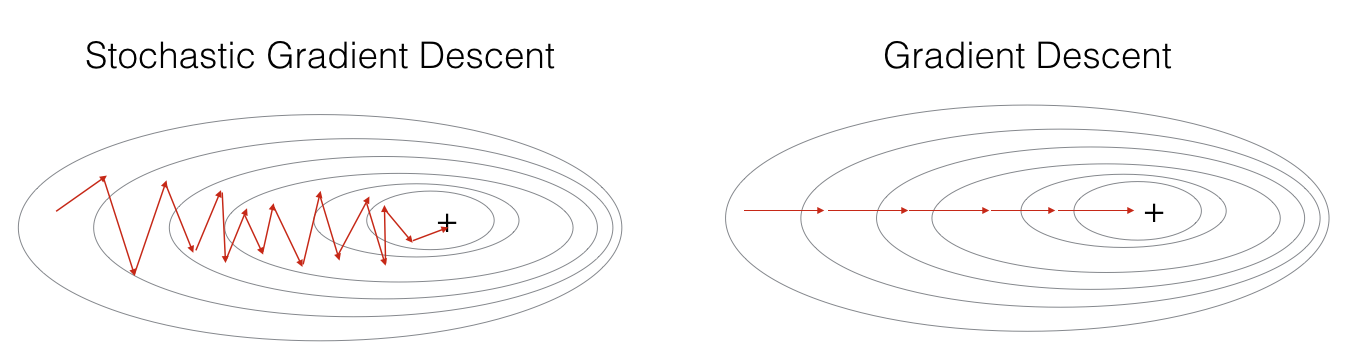
Figure 1 : SGD vs GD
"+" 表示代价函数的最低点. SGD 震荡剧烈直到收敛. 但是,由于 SGD只用一个样本而不是所有样本计算梯度,因此它的每一步要远快于GD.

SGD实现过程有3个循环: 1. 迭代循环Over the number of iterations 2. \(m\)个样本循环 3. 层数循环 (以更新所有参数, 从 \((W^{[1]},b^{[1]})\)\((W^{[L]},b^{[L]})\))

相比较而言,Mini-batch gradient descent 每一步使用一部分样本. 不需要对每个样本循环,而是对每个batch循环. 这样不仅减少震荡,而且可以利用python的向量化特点,加快收敛速度。
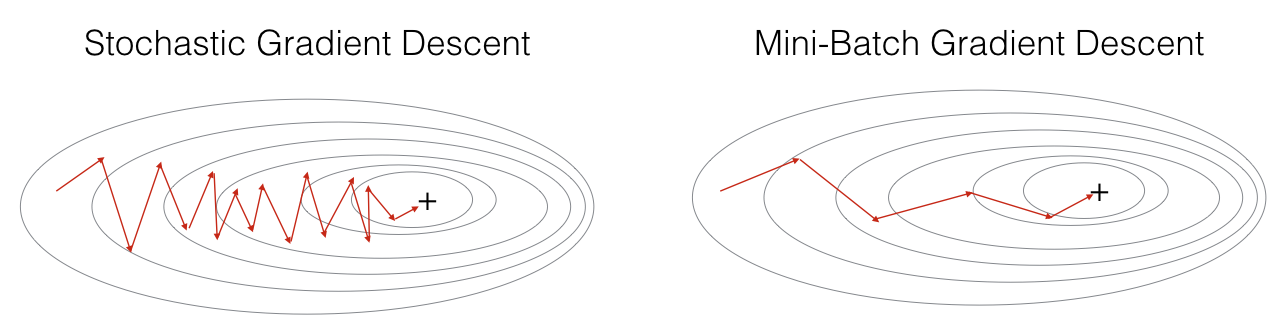
Figure 2 : SGD vs Mini-Batch GD
"+" 表示代价函数的最低点. 利用 mini-batches 往往是最快的优化方式.

小结: - gradient descent, mini-batch gradient descent and stochastic gradient descent的差异在于每次模型更新所用的样本个数. - mini-batch需要不停调整. - 使用合理的 mini-batch 大小, mini-batch方法往往由于gradient descent 和 stochastic gradient descent 方法(尤其是当训练集很大的情况).

Mini-Batch 梯度下降法

从训练集(X, Y)建立mini-batches可以分两步:

  • Shuffle: 建立训练集的 shuffled 版本,如下图所示. X 和 Y 每一列代表一个训练样本. 注意是同时对X 和 Y进行随机 shuffling. 这样才能保证shuffling 之后X的第 \(i^{th}\)X 和Y的 \(i^{th}\) 仍然是对应起来的. shuffling 使得样本是随机分割成不同的mini-batches.
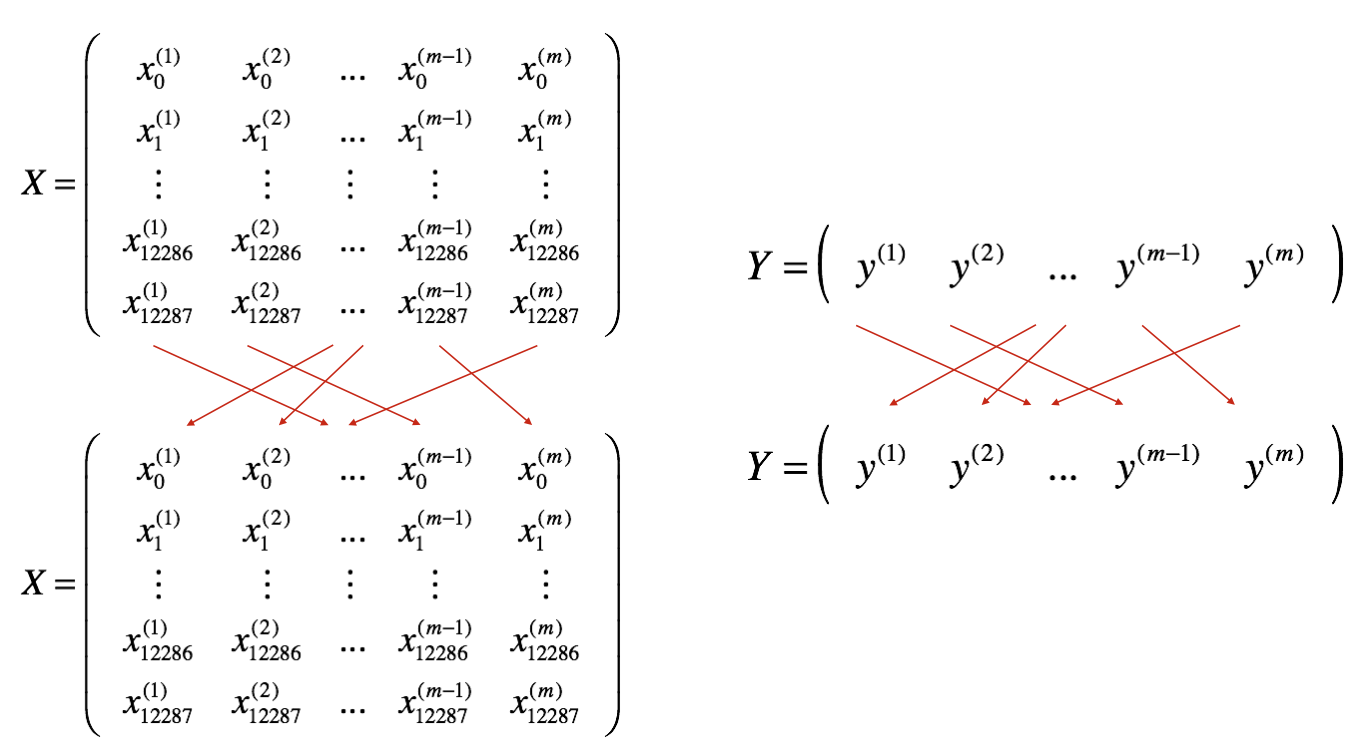
  • Partition: 将shuffled之后的(X, Y) 分割成大小为 mini_batch_size (here 64)的mini-batches. 注意训练样本不一定可以整除 mini_batch_size. 最后的mini-batche可能比较小, 当它小于完整的 mini_batch_size时:

实现了Shuffle之后,选择第1和第2个mini-batches的代码为:

1
2
3
first_mini_batch_X = shuffled_X[:, 0 : mini_batch_size]
second_mini_batch_X = shuffled_X[:, mini_batch_size : 2 * mini_batch_size]
...

注意到最后的min-batch可能小于mini_batch_size=64. 令 \(\lfloor s \rfloor\) 表示 对\(s\) 不大于它的整数 (也就是python中的 math.floor(s)). 如果总样本数不是mini_batch_size=64的乘积,那么会有 \(\lfloor \frac{m}{mini\_batch\_size}\rfloor\) 个64 样本的mini-batch, 而最后的mini-batch 大小为 (\(m-mini_\_batch_\_size \times \lfloor \frac{m}{mini\_batch\_size}\rfloor\)).

1
2
3
4
5
6
7
8
9
10
11
12
13
14
15
16
17
18
19
20
21
22
23
24
25
26
27
28
29
30
31
32
33
34
35
36
37
38
39
40
41
42
43
44
# GRADED FUNCTION: random_mini_batches

def random_mini_batches(X, Y, mini_batch_size = 64, seed = 0):
"""
Creates a list of random minibatches from (X, Y)

Arguments:
X -- input data, of shape (input size, number of examples)
Y -- true "label" vector (1 for blue dot / 0 for red dot), of shape (1, number of examples)
mini_batch_size -- size of the mini-batches, integer

Returns:
mini_batches -- list of synchronous (mini_batch_X, mini_batch_Y)
"""

np.random.seed(seed) # To make your "random" minibatches the same as ours
m = X.shape[1] # number of training examples
mini_batches = []

# Step 1: Shuffle (X, Y)
permutation = list(np.random.permutation(m))
shuffled_X = X[:, permutation]
shuffled_Y = Y[:, permutation].reshape((1,m))

# Step 2: Partition (shuffled_X, shuffled_Y). Minus the end case.
num_complete_minibatches = math.floor(m/mini_batch_size) # number of mini batches of size mini_batch_size in your partitionning
for k in range(0, num_complete_minibatches):
### START CODE HERE ### (approx. 2 lines)
mini_batch_X = shuffled_X[:, k*mini_batch_size : (k+1)*mini_batch_size]
mini_batch_Y = shuffled_Y[:, k*mini_batch_size : (k+1)*mini_batch_size]
### END CODE HERE ###
mini_batch = (mini_batch_X, mini_batch_Y)
mini_batches.append(mini_batch)

# Handling the end case (last mini-batch < mini_batch_size)
if m % mini_batch_size != 0:
### START CODE HERE ### (approx. 2 lines)
mini_batch_X = shuffled_X[:, num_complete_minibatches*mini_batch_size:]
mini_batch_Y = shuffled_Y[:, num_complete_minibatches*mini_batch_size:]
### END CODE HERE ###
mini_batch = (mini_batch_X, mini_batch_Y)
mini_batches.append(mini_batch)

return mini_batches
1
2
3
4
5
6
7
8
9
10
X_assess, Y_assess, mini_batch_size = random_mini_batches_test_case()
mini_batches = random_mini_batches(X_assess, Y_assess, mini_batch_size)

print ("shape of the 1st mini_batch_X: " + str(mini_batches[0][0].shape))
print ("shape of the 2nd mini_batch_X: " + str(mini_batches[1][0].shape))
print ("shape of the 3rd mini_batch_X: " + str(mini_batches[2][0].shape))
print ("shape of the 1st mini_batch_Y: " + str(mini_batches[0][1].shape))
print ("shape of the 2nd mini_batch_Y: " + str(mini_batches[1][1].shape))
print ("shape of the 3rd mini_batch_Y: " + str(mini_batches[2][1].shape))
print ("mini batch sanity check: " + str(mini_batches[0][0][0][0:3]))
shape of the 1st mini_batch_X: (12288, 64)
shape of the 2nd mini_batch_X: (12288, 64)
shape of the 3rd mini_batch_X: (12288, 20)
shape of the 1st mini_batch_Y: (1, 64)
shape of the 2nd mini_batch_Y: (1, 64)
shape of the 3rd mini_batch_Y: (1, 20)
mini batch sanity check: [ 0.90085595 -0.7612069   0.2344157 ]

小结:

  1. Shuffling 和 Partitioning 是生成min-batch的两步
  2. 2的次方往往选做min-batch的大小,如16,32,64,128d.

动量

由于mini-batch梯度下降法每次参数更新都仅仅用了一部分数据,因此更新方向会有一些震荡。采用动量可以减少这种震荡。

动量策略考虑了以前的梯度信息以对更新量进行平滑处理。之前的梯度方向会存在变量 \(v\)中。更准确的说,\(v\)是之前梯度的指数加权平均。也可以把\(v\)看做球往山下滚的速度,新计算的梯度作为动量修正\(v\).
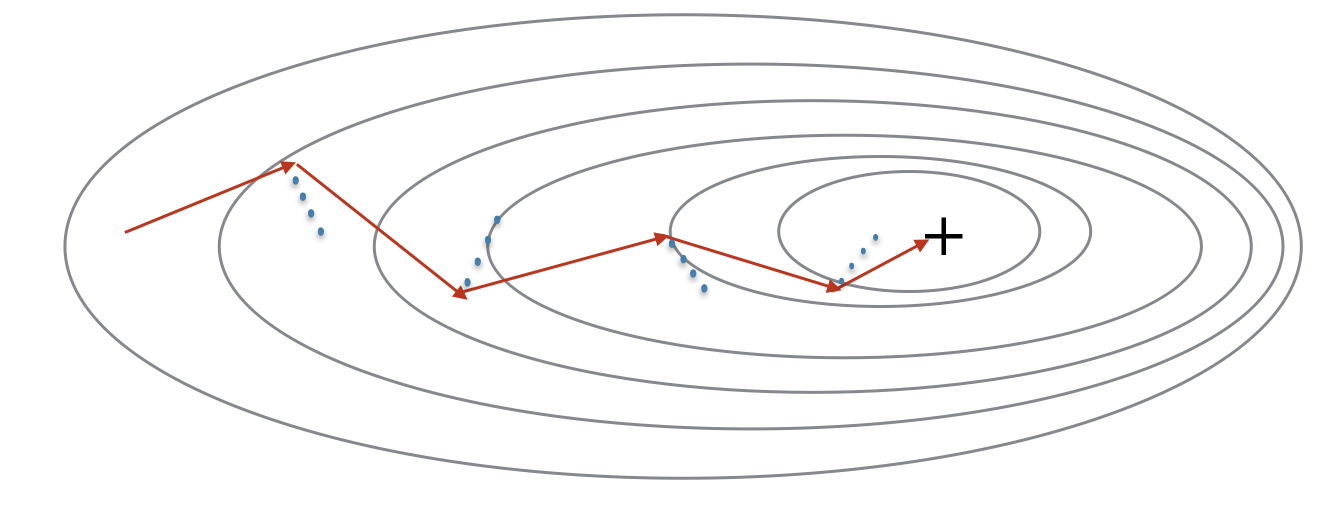
图 3: 红线表示带动量的mini-batch梯度下降法更新方向,蓝色点表示梯度方向. 与直接使用梯度方向不同,这种方法让梯度影响\(v\), 然后沿着\(v\)的方向更新.

动量更新, 循环 \(l = 1, ..., L\):

\[ \begin{cases} v_{dW^{[l]}} = \beta v_{dW^{[l]}} + (1 - \beta) dW^{[l]} \\ W^{[l]} = W^{[l]} - \alpha v_{dW^{[l]}} \end{cases}\tag{3}\]

\[\begin{cases} v_{db^{[l]}} = \beta v_{db^{[l]}} + (1 - \beta) db^{[l]} \\ b^{[l]} = b^{[l]} - \alpha v_{db^{[l]}} \end{cases}\tag{4}\]

其中 L 为层数, \(\beta\) 为动量, \(\alpha\)为学习率.

1
2
3
4
5
6
7
8
9
10
11
12
13
14
15
16
17
18
19
20
21
22
23
24
25
26
27
28
29
# GRADED FUNCTION: initialize_velocity

def initialize_velocity(parameters):
"""
Initializes the velocity as a python dictionary with:
- keys: "dW1", "db1", ..., "dWL", "dbL"
- values: numpy arrays of zeros of the same shape as the corresponding gradients/parameters.
Arguments:
parameters -- python dictionary containing your parameters.
parameters['W' + str(l)] = Wl
parameters['b' + str(l)] = bl

Returns:
v -- python dictionary containing the current velocity.
v['dW' + str(l)] = velocity of dWl
v['db' + str(l)] = velocity of dbl
"""

L = len(parameters) // 2 # number of layers in the neural networks
v = {}

# Initialize velocity
for l in range(L):
### START CODE HERE ### (approx. 2 lines)
v["dW" + str(l+1)] = np.zeros(parameters['W'+str(l+1)].shape)
v["db" + str(l+1)] = np.zeros(parameters['b'+str(l+1)].shape)
### END CODE HERE ###

return v
1
2
3
4
5
6
7
parameters = initialize_velocity_test_case()

v = initialize_velocity(parameters)
print("v[\"dW1\"] = " + str(v["dW1"]))
print("v[\"db1\"] = " + str(v["db1"]))
print("v[\"dW2\"] = " + str(v["dW2"]))
print("v[\"db2\"] = " + str(v["db2"]))
v["dW1"] = [[ 0.  0.  0.]
 [ 0.  0.  0.]]
v["db1"] = [[ 0.]
 [ 0.]]
v["dW2"] = [[ 0.  0.  0.]
 [ 0.  0.  0.]
 [ 0.  0.  0.]]
v["db2"] = [[ 0.]
 [ 0.]
 [ 0.]]
1
2
3
4
5
6
7
8
9
10
11
12
13
14
15
16
17
18
19
20
21
22
23
24
25
26
27
28
29
30
31
32
33
34
35
36
37
38
39
# GRADED FUNCTION: update_parameters_with_momentum

def update_parameters_with_momentum(parameters, grads, v, beta, learning_rate):
"""
Update parameters using Momentum

Arguments:
parameters -- python dictionary containing your parameters:
parameters['W' + str(l)] = Wl
parameters['b' + str(l)] = bl
grads -- python dictionary containing your gradients for each parameters:
grads['dW' + str(l)] = dWl
grads['db' + str(l)] = dbl
v -- python dictionary containing the current velocity:
v['dW' + str(l)] = ...
v['db' + str(l)] = ...
beta -- the momentum hyperparameter, scalar
learning_rate -- the learning rate, scalar

Returns:
parameters -- python dictionary containing your updated parameters
v -- python dictionary containing your updated velocities
"""

L = len(parameters) // 2 # number of layers in the neural networks

# Momentum update for each parameter
for l in range(L):

### START CODE HERE ### (approx. 4 lines)
# compute velocities
v["dW" + str(l+1)] = beta * v['dW' + str(l+1)] + (1-beta)*(grads['dW' + str(l+1)])
v["db" + str(l+1)] = beta * v['db' + str(l+1)] + (1-beta)*(grads['db' + str(l+1)])
# update parameters
parameters["W" + str(l+1)] = parameters['W' + str(l+1)] - learning_rate * v['dW' + str(l+1)]
parameters["b" + str(l+1)] = parameters['b' + str(l+1)] - learning_rate * v['db' + str(l+1)]
### END CODE HERE ###

return parameters, v
1
2
3
4
5
6
7
8
9
10
11
parameters, grads, v = update_parameters_with_momentum_test_case()

parameters, v = update_parameters_with_momentum(parameters, grads, v, beta = 0.9, learning_rate = 0.01)
print("W1 = " + str(parameters["W1"]))
print("b1 = " + str(parameters["b1"]))
print("W2 = " + str(parameters["W2"]))
print("b2 = " + str(parameters["b2"]))
print("v[\"dW1\"] = " + str(v["dW1"]))
print("v[\"db1\"] = " + str(v["db1"]))
print("v[\"dW2\"] = " + str(v["dW2"]))
print("v[\"db2\"] = " + str(v["db2"]))
W1 = [[ 1.62544598 -0.61290114 -0.52907334]
 [-1.07347112  0.86450677 -2.30085497]]
b1 = [[ 1.74493465]
 [-0.76027113]]
W2 = [[ 0.31930698 -0.24990073  1.4627996 ]
 [-2.05974396 -0.32173003 -0.38320915]
 [ 1.13444069 -1.0998786  -0.1713109 ]]
b2 = [[-0.87809283]
 [ 0.04055394]
 [ 0.58207317]]
v["dW1"] = [[-0.11006192  0.11447237  0.09015907]
 [ 0.05024943  0.09008559 -0.06837279]]
v["db1"] = [[-0.01228902]
 [-0.09357694]]
v["dW2"] = [[-0.02678881  0.05303555 -0.06916608]
 [-0.03967535 -0.06871727 -0.08452056]
 [-0.06712461 -0.00126646 -0.11173103]]
v["db2"] = [[ 0.02344157]
 [ 0.16598022]
 [ 0.07420442]]

如何选择\(\beta\):

  • \(\beta\)越大,则考虑更多以前的梯度,更新越平滑,如果过大,会导平滑掉有效更新量
  • \(\beta\)常见的取值范围从0.8到0.999,如果不想调这个参数,\(\beta=0.9\)往往是一个合理的选择

小结:

  • 动量方法考虑之前的梯度信息,以平滑梯度下降法的搜索方向,可以应用在batch GD, mini-batch GD和随机GD方法中
  • 增加了一个超级参数\(\beta\)需要调整

Adam方法

Adam方法是神经网络中最有效的优化算法,它结合了RMSProp和动量两种方法的思想。

Adam 工作原理 1. 计算之前梯度的指数加权平均,并保存在变量\(v\)中 (偏差校正前) 和 \(v^{corrected}\) (偏差校正后). 2. 计算之前梯度平方的指数加权平均,并保存在变量\(s\)中 (偏差校正前) 和 \(s^{corrected}\) (偏差校正后). 3. 结合步骤 "1" 和 "2"得到新的更新方向,对模型进行更新.

更新准则是, 循环 \(l = 1, ..., L\):

\[\begin{cases} v_{dW^{[l]}} = \beta_1 v_{dW^{[l]}} + (1 - \beta_1) \frac{\partial \mathcal{J} }{ \partial W^{[l]} } \\ v^{corrected}_{dW^{[l]}} = \frac{v_{dW^{[l]}}}{1 - (\beta_1)^t} \\ s_{dW^{[l]}} = \beta_2 s_{dW^{[l]}} + (1 - \beta_2) (\frac{\partial \mathcal{J} }{\partial W^{[l]} })^2 \\ s^{corrected}_{dW^{[l]}} = \frac{s_{dW^{[l]}}}{1 - (\beta_1)^t} \\ W^{[l]} = W^{[l]} - \alpha \frac{v^{corrected}_{dW^{[l]}}}{\sqrt{s^{corrected}_{dW^{[l]}}} + \varepsilon} \end{cases}\] 其中: - t 计算Adam的步数
- L 层数
- \(\beta_1\)\(\beta_2\) 为控制两个指数加权平均的超参
- \(\alpha\) 为学习率
- \(\varepsilon\) 避免除0的小值

1
2
3
4
5
6
7
8
9
10
11
12
13
14
15
16
17
18
19
20
21
22
23
24
25
26
27
28
29
30
31
32
33
34
35
36
37
# GRADED FUNCTION: initialize_adam

def initialize_adam(parameters) :
"""
Initializes v and s as two python dictionaries with:
- keys: "dW1", "db1", ..., "dWL", "dbL"
- values: numpy arrays of zeros of the same shape as the corresponding gradients/parameters.

Arguments:
parameters -- python dictionary containing your parameters.
parameters["W" + str(l)] = Wl
parameters["b" + str(l)] = bl

Returns:
v -- python dictionary that will contain the exponentially weighted average of the gradient.
v["dW" + str(l)] = ...
v["db" + str(l)] = ...
s -- python dictionary that will contain the exponentially weighted average of the squared gradient.
s["dW" + str(l)] = ...
s["db" + str(l)] = ...

"""

L = len(parameters) // 2 # number of layers in the neural networks
v = {}
s = {}

# Initialize v, s. Input: "parameters". Outputs: "v, s".
for l in range(L):
### START CODE HERE ### (approx. 4 lines)
v["dW" + str(l+1)] = np.zeros(parameters['W' + str(l+1)].shape)
v["db" + str(l+1)] = np.zeros(parameters['b' + str(l+1)].shape)
s["dW" + str(l+1)] = np.zeros(parameters['W' + str(l+1)].shape)
s["db" + str(l+1)] = np.zeros(parameters['b' + str(l+1)].shape)
### END CODE HERE ###

return v, s
1
2
3
4
5
6
7
8
9
10
11
parameters = initialize_adam_test_case()

v, s = initialize_adam(parameters)
print("v[\"dW1\"] = " + str(v["dW1"]))
print("v[\"db1\"] = " + str(v["db1"]))
print("v[\"dW2\"] = " + str(v["dW2"]))
print("v[\"db2\"] = " + str(v["db2"]))
print("s[\"dW1\"] = " + str(s["dW1"]))
print("s[\"db1\"] = " + str(s["db1"]))
print("s[\"dW2\"] = " + str(s["dW2"]))
print("s[\"db2\"] = " + str(s["db2"]))
v["dW1"] = [[ 0.  0.  0.]
 [ 0.  0.  0.]]
v["db1"] = [[ 0.]
 [ 0.]]
v["dW2"] = [[ 0.  0.  0.]
 [ 0.  0.  0.]
 [ 0.  0.  0.]]
v["db2"] = [[ 0.]
 [ 0.]
 [ 0.]]
s["dW1"] = [[ 0.  0.  0.]
 [ 0.  0.  0.]]
s["db1"] = [[ 0.]
 [ 0.]]
s["dW2"] = [[ 0.  0.  0.]
 [ 0.  0.  0.]
 [ 0.  0.  0.]]
s["db2"] = [[ 0.]
 [ 0.]
 [ 0.]]
1
2
3
4
5
6
7
8
9
10
11
12
13
14
15
16
17
18
19
20
21
22
23
24
25
26
27
28
29
30
31
32
33
34
35
36
37
38
39
40
41
42
43
44
45
46
47
48
49
50
51
52
53
54
55
56
57
58
59
60
61
62
63
64
# GRADED FUNCTION: update_parameters_with_adam

def update_parameters_with_adam(parameters, grads, v, s, t, learning_rate = 0.01,
beta1 = 0.9, beta2 = 0.999, epsilon = 1e-8):
"""
Update parameters using Adam

Arguments:
parameters -- python dictionary containing your parameters:
parameters['W' + str(l)] = Wl
parameters['b' + str(l)] = bl
grads -- python dictionary containing your gradients for each parameters:
grads['dW' + str(l)] = dWl
grads['db' + str(l)] = dbl
v -- Adam variable, moving average of the first gradient, python dictionary
s -- Adam variable, moving average of the squared gradient, python dictionary
learning_rate -- the learning rate, scalar.
beta1 -- Exponential decay hyperparameter for the first moment estimates
beta2 -- Exponential decay hyperparameter for the second moment estimates
epsilon -- hyperparameter preventing division by zero in Adam updates

Returns:
parameters -- python dictionary containing your updated parameters
v -- Adam variable, moving average of the first gradient, python dictionary
s -- Adam variable, moving average of the squared gradient, python dictionary
"""

L = len(parameters) // 2 # number of layers in the neural networks
v_corrected = {} # Initializing first moment estimate, python dictionary
s_corrected = {} # Initializing second moment estimate, python dictionary

# Perform Adam update on all parameters
for l in range(L):
# Moving average of the gradients. Inputs: "v, grads, beta1". Output: "v".
### START CODE HERE ### (approx. 2 lines)
v["dW" + str(l+1)] = beta1 * v['dW' + str(l+1)] + (1-beta1) * grads['dW' + str(l+1)]
v["db" + str(l+1)] = beta1 * v['db' + str(l+1)] + (1-beta1) * grads['db' + str(l+1)]
### END CODE HERE ###

# Compute bias-corrected first moment estimate. Inputs: "v, beta1, t". Output: "v_corrected".
### START CODE HERE ### (approx. 2 lines)
v_corrected["dW" + str(l+1)] = v['dW' + str(l+1)] / (1 - np.power(beta1, t))
v_corrected["db" + str(l+1)] = v['db' + str(l+1)] / (1 - np.power(beta1, t))
### END CODE HERE ###

# Moving average of the squared gradients. Inputs: "s, grads, beta2". Output: "s".
### START CODE HERE ### (approx. 2 lines)
s["dW" + str(l+1)] = beta2 * s['dW' + str(l+1)] + (1-beta2) * np.power(grads['dW' + str(l+1)], 2)
s["db" + str(l+1)] = beta2 * s['db' + str(l+1)] + (1-beta2) * np.power(grads['db' + str(l+1)], 2)
### END CODE HERE ###

# Compute bias-corrected second raw moment estimate. Inputs: "s, beta2, t". Output: "s_corrected".
### START CODE HERE ### (approx. 2 lines)
s_corrected["dW" + str(l+1)] = s['dW' + str(l+1)] / (1 - np.power(beta2, t))
s_corrected["db" + str(l+1)] = s['db' + str(l+1)] / (1 - np.power(beta2, t))
### END CODE HERE ###

# Update parameters. Inputs: "parameters, learning_rate, v_corrected, s_corrected, epsilon". Output: "parameters".
### START CODE HERE ### (approx. 2 lines)
parameters["W" + str(l+1)] = parameters['W' + str(l+1)] - learning_rate * v_corrected['dW' + str(l+1)] / np.sqrt(s_corrected['dW' + str(l+1)] + epsilon)
parameters["b" + str(l+1)] = parameters['b' + str(l+1)] - learning_rate * v_corrected['db' + str(l+1)] / np.sqrt(s_corrected['db' + str(l+1)] + epsilon)
### END CODE HERE ###

return parameters, v, s
1
2
3
4
5
6
7
8
9
10
11
12
13
14
15
parameters, grads, v, s = update_parameters_with_adam_test_case()
parameters, v, s = update_parameters_with_adam(parameters, grads, v, s, t = 2)

print("W1 = " + str(parameters["W1"]))
print("b1 = " + str(parameters["b1"]))
print("W2 = " + str(parameters["W2"]))
print("b2 = " + str(parameters["b2"]))
print("v[\"dW1\"] = " + str(v["dW1"]))
print("v[\"db1\"] = " + str(v["db1"]))
print("v[\"dW2\"] = " + str(v["dW2"]))
print("v[\"db2\"] = " + str(v["db2"]))
print("s[\"dW1\"] = " + str(s["dW1"]))
print("s[\"db1\"] = " + str(s["db1"]))
print("s[\"dW2\"] = " + str(s["dW2"]))
print("s[\"db2\"] = " + str(s["db2"]))
W1 = [[ 1.63178673 -0.61919778 -0.53561312]
 [-1.08040999  0.85796626 -2.29409733]]
b1 = [[ 1.75225313]
 [-0.75376553]]
W2 = [[ 0.32648046 -0.25681174  1.46954931]
 [-2.05269934 -0.31497584 -0.37661299]
 [ 1.14121081 -1.09245036 -0.16498684]]
b2 = [[-0.88529978]
 [ 0.03477238]
 [ 0.57537385]]
v["dW1"] = [[-0.11006192  0.11447237  0.09015907]
 [ 0.05024943  0.09008559 -0.06837279]]
v["db1"] = [[-0.01228902]
 [-0.09357694]]
v["dW2"] = [[-0.02678881  0.05303555 -0.06916608]
 [-0.03967535 -0.06871727 -0.08452056]
 [-0.06712461 -0.00126646 -0.11173103]]
v["db2"] = [[ 0.02344157]
 [ 0.16598022]
 [ 0.07420442]]
s["dW1"] = [[ 0.00121136  0.00131039  0.00081287]
 [ 0.0002525   0.00081154  0.00046748]]
s["db1"] = [[  1.51020075e-05]
 [  8.75664434e-04]]
s["dW2"] = [[  7.17640232e-05   2.81276921e-04   4.78394595e-04]
 [  1.57413361e-04   4.72206320e-04   7.14372576e-04]
 [  4.50571368e-04   1.60392066e-07   1.24838242e-03]]
s["db2"] = [[  5.49507194e-05]
 [  2.75494327e-03]
 [  5.50629536e-04]]

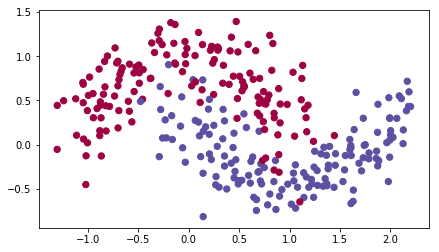
测试不同的优化算法

1
train_X, train_Y = load_dataset()
png

png

1
2
3
4
5
6
7
8
9
10
11
12
13
14
15
16
17
18
19
20
21
22
23
24
25
26
27
28
29
30
31
32
33
34
35
36
37
38
39
40
41
42
43
44
45
46
47
48
49
50
51
52
53
54
55
56
57
58
59
60
61
62
63
64
65
66
67
68
69
70
71
72
73
74
75
76
77
78
79
80
81
82
83
def model(X, Y, layers_dims, optimizer, learning_rate = 0.0007, mini_batch_size = 64, beta = 0.9,
beta1 = 0.9, beta2 = 0.999, epsilon = 1e-8, num_epochs = 10000, print_cost = True):
"""
3-layer neural network model which can be run in different optimizer modes.

Arguments:
X -- input data, of shape (2, number of examples)
Y -- true "label" vector (1 for blue dot / 0 for red dot), of shape (1, number of examples)
layers_dims -- python list, containing the size of each layer
learning_rate -- the learning rate, scalar.
mini_batch_size -- the size of a mini batch
beta -- Momentum hyperparameter
beta1 -- Exponential decay hyperparameter for the past gradients estimates
beta2 -- Exponential decay hyperparameter for the past squared gradients estimates
epsilon -- hyperparameter preventing division by zero in Adam updates
num_epochs -- number of epochs
print_cost -- True to print the cost every 1000 epochs

Returns:
parameters -- python dictionary containing your updated parameters
"""

L = len(layers_dims) # number of layers in the neural networks
costs = [] # to keep track of the cost
t = 0 # initializing the counter required for Adam update
seed = 10 # For grading purposes, so that your "random" minibatches are the same as ours

# Initialize parameters
parameters = initialize_parameters(layers_dims)

# Initialize the optimizer
if optimizer == "gd":
pass # no initialization required for gradient descent
elif optimizer == "momentum":
v = initialize_velocity(parameters)
elif optimizer == "adam":
v, s = initialize_adam(parameters)

# Optimization loop
for i in range(num_epochs):

# Define the random minibatches. We increment the seed to reshuffle differently the dataset after each epoch
seed = seed + 1
minibatches = random_mini_batches(X, Y, mini_batch_size, seed)

for minibatch in minibatches:

# Select a minibatch
(minibatch_X, minibatch_Y) = minibatch

# Forward propagation
a3, caches = forward_propagation(minibatch_X, parameters)

# Compute cost
cost = compute_cost(a3, minibatch_Y)

# Backward propagation
grads = backward_propagation(minibatch_X, minibatch_Y, caches)

# Update parameters
if optimizer == "gd":
parameters = update_parameters_with_gd(parameters, grads, learning_rate)
elif optimizer == "momentum":
parameters, v = update_parameters_with_momentum(parameters, grads, v, beta, learning_rate)
elif optimizer == "adam":
t = t + 1 # Adam counter
parameters, v, s = update_parameters_with_adam(parameters, grads, v, s,
t, learning_rate, beta1, beta2, epsilon)

# Print the cost every 1000 epoch
if print_cost and i % 1000 == 0:
print ("Cost after epoch %i: %f" %(i, cost))
if print_cost and i % 100 == 0:
costs.append(cost)

# plot the cost
plt.plot(costs)
plt.ylabel('cost')
plt.xlabel('epochs (per 100)')
plt.title("Learning rate = " + str(learning_rate))
plt.show()

return parameters

Mini-batch梯度下降法

1
2
3
4
5
6
7
8
9
10
11
12
13
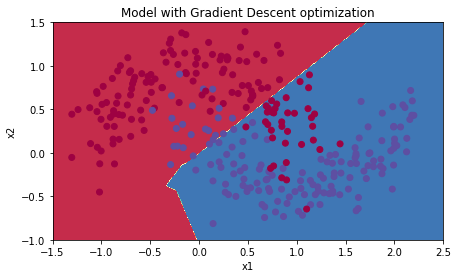
# train 3-layer model
layers_dims = [train_X.shape[0], 5, 2, 1]
parameters = model(train_X, train_Y, layers_dims, optimizer = "gd")

# Predict
predictions = predict(train_X, train_Y, parameters)

# Plot decision boundary
plt.title("Model with Gradient Descent optimization")
axes = plt.gca()
axes.set_xlim([-1.5,2.5])
axes.set_ylim([-1,1.5])
plot_decision_boundary(lambda x: predict_dec(parameters, x.T), train_X, train_Y)
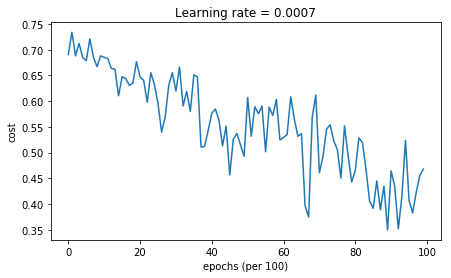
Cost after epoch 0: 0.690736
Cost after epoch 1000: 0.685273
Cost after epoch 2000: 0.647072
Cost after epoch 3000: 0.619525
Cost after epoch 4000: 0.576584
Cost after epoch 5000: 0.607243
Cost after epoch 6000: 0.529403
Cost after epoch 7000: 0.460768
Cost after epoch 8000: 0.465586
Cost after epoch 9000: 0.464518
png

png

Accuracy: 0.796666666667
png

png

带动量的Mini-batch梯度下降法

1
2
3
4
5
6
7
8
9
10
11
12
13
# train 3-layer model
layers_dims = [train_X.shape[0], 5, 2, 1]
parameters = model(train_X, train_Y, layers_dims, beta = 0.9, optimizer = "momentum")

# Predict
predictions = predict(train_X, train_Y, parameters)

# Plot decision boundary
plt.title("Model with Momentum optimization")
axes = plt.gca()
axes.set_xlim([-1.5,2.5])
axes.set_ylim([-1,1.5])
plot_decision_boundary(lambda x: predict_dec(parameters, x.T), train_X, train_Y)
Cost after epoch 0: 0.690741
Cost after epoch 1000: 0.685341
Cost after epoch 2000: 0.647145
Cost after epoch 3000: 0.619594
Cost after epoch 4000: 0.576665
Cost after epoch 5000: 0.607324
Cost after epoch 6000: 0.529476
Cost after epoch 7000: 0.460936
Cost after epoch 8000: 0.465780
Cost after epoch 9000: 0.464740
png

png

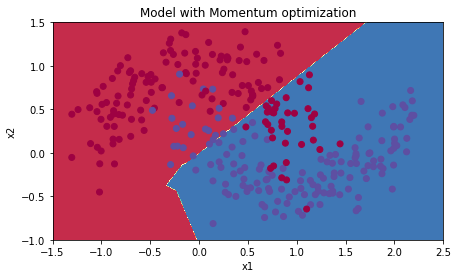
Accuracy: 0.796666666667
png

png

Adam模式下的Mini-batch梯度下降法

1
2
3
4
5
6
7
8
9
10
11
12
13
# train 3-layer model
layers_dims = [train_X.shape[0], 5, 2, 1]
parameters = model(train_X, train_Y, layers_dims, optimizer = "adam")

# Predict
predictions = predict(train_X, train_Y, parameters)

# Plot decision boundary
plt.title("Model with Adam optimization")
axes = plt.gca()
axes.set_xlim([-1.5,2.5])
axes.set_ylim([-1,1.5])
plot_decision_boundary(lambda x: predict_dec(parameters, x.T), train_X, train_Y)
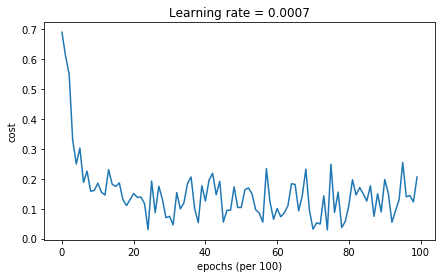
Cost after epoch 0: 0.690552
Cost after epoch 1000: 0.185501
Cost after epoch 2000: 0.150830
Cost after epoch 3000: 0.074454
Cost after epoch 4000: 0.125959
Cost after epoch 5000: 0.104344
Cost after epoch 6000: 0.100676
Cost after epoch 7000: 0.031652
Cost after epoch 8000: 0.111973
Cost after epoch 9000: 0.197940
png

png

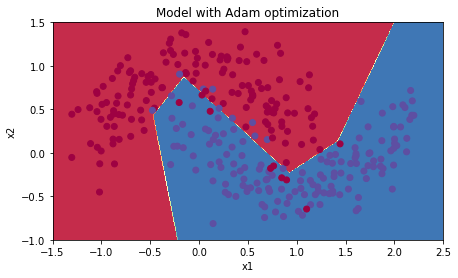
Accuracy: 0.94
png

png

结论

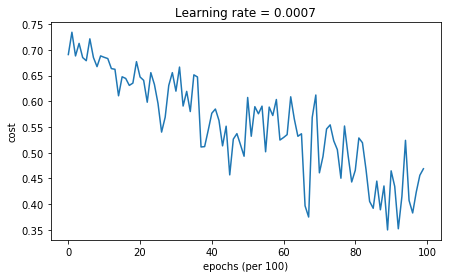
  1. 动量法往往有帮助,但是对于小的学习率和简单数据集,影响几乎可以忽略。
  2. 代价函数的剧烈波动来自于对优化算法来说,一些minibatch更加复制。
  3. Adam方法明显优于min-batch梯度下降法和动量法,但是如果给予足够的迭代次数,所有三种方法的结果会类似。但是,Adam方法收敛速度快得多。
  4. Adam方法的优点包括:仅需要很小的内存;往往不需要调参就可以工作很好(学习率除外)。

参考资料